
Kato Panagia, Asia Minor
At a Glance
Location: Erythraea Peninsula, opposite the island of Chios
Population in 1922: approximately 7,000 Greek inhabitants
Churches: 3 main churches and 18 chapels
Schools: Boys' School, Hellenic School and Girls' School
Associations: "Argennon" and "Omonoia"
Main Crops: Raisins, Tobacco and Cotton
Economy: Agriculture, Fishing, Maritime Trade and Weaving
Present-day name: Çiftlik
Location
Kato Panagia was situated at the westernmost tip of Asia Minor, opposite the island of Chios and south of Krini (Çeşme). The area was already mentioned by the ancient historian Thucydides as “Embaton, near Cape Argennon.”
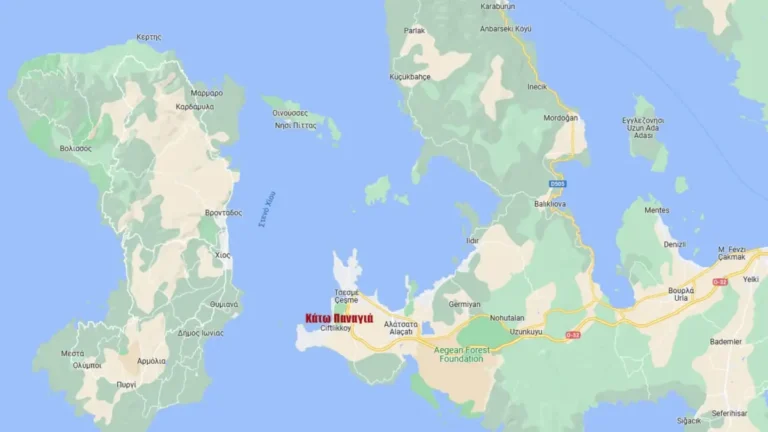
Discover Kato Panagia
Economy
The agricultural area of Kato Panagia comprised 70,000 stremmas of fertile land, which, together with the sea, constituted the village's wealth.
The products cultivated were raisins and tobacco, which were exported to Europe and America; cereals and legumes were grown only to meet the village's own needs. Shipping and fishing were significant due to the village's coastal location, alongside a developed textile industry and cotton cultivation.
Education
Kato Panagia was home to a full Boys' School (a six-grade primary school operating since 1831), a Greek School (established in 1857), and a Girls' School (established in 1863). During the years of Ottoman rule, a "secret school" and a Greek school had operated there. Our schools followed the curriculum of the Evangelical School of Smyrna.
Culture
The developed perception and love of its inhabitants for letters was distinctive. In 1878, despite the Turkish occupation, the "To Argennon" Literary Society giving theatrical performances with ancient dramas. In 1893 the Association was founded Omónoia.
Administration
The village was governed by the Council of Elders (*Demogerontia*), which held immense power. In 1886, Kato Panagia was upgraded to the Municipality of Kato Panagia, with Nikolaos Limnioudis serving as its first Mayor. The municipality carried out numerous projects in the village and was also responsible for maintaining order, employing both rural guards (*dragates*) and night watchmen. All community works were executed by the Municipality.
Following the return of the residents of Kato Panagia to their devastated village with the Greek army in 1919, the Greek Community of Kato Panagia was established.
Churches
The village's great church of Panagia—dedicated to the Dormition of the Theotokos—was magnificent. The church measured 30 meters in length and 16 in width. The women's gallery rested on ten columns that had almost certainly once belonged to an ancient temple in Ephesus or Miletus.
Kato Panagia also had the churches of Saint Demetrios and Saint Nicholas, as well as 18 outlying chapels. Administratively, it belonged to the Metropolis of Krini (Çeşme).
Folklore
Kato Panagia preserved its Greek identity and maintained its ancient customs and traditions, its songs, and its ancient Greek and Byzantine dances. It also preserved all the ancient Greek names.
The festivities had an old-world feel—such as the procession of Saint George at sea, the boat outings on Ascension Day, *Niotrito*, and the Carnival celebrations.
Proverbs, rhymes, couplets, lullabies, laments, songs, and the famous Lament of the Virgin Mary were published in the journal of the Literary Society of Constantinople.
The folklore was preserved by Antonios Poulakis, a teacher and secretary of the Holy Metropolis of Krini. The collection of folklore from Kato Panagia was awarded prizes in Constantinople and Athens and was used by Eleftherios Venizelos during the 1920 Treaty of Sèvres to demonstrate the Greek character of Asia Minor.
In Kato Panagia, hand-loom weaving flourished as a continuation of the weaving traditions of antiquity. The motifs found on the village's textiles include meanders, swans, and palm trees arranged in geometric patterns reminiscent of ancient Greek pottery, alongside embroidery featuring Mycenaean-style motifs.
In Kato Panagia, white and red cotton were cultivated. From this unique product of the village, the red cotton they wove the renowned "red-cotton textiles" that adorn the display cases of the Kato Panagia Folklore Museum.
Contribution to the National Struggles
Kato Panagia’s participation in the national struggles is rich and proud.
He participated in the movement of Rigas Feraios alongside Christodoulos Pantazis (an ancestor of the Pantazidis family)—a member of the Filiki Etaireia and founder of the secret school in Kato Panagia. He was executed by the Turks in 1822.
In the Revolution of 1821, with the participation of 40 of our fellow villagers in the Ionian Phalanx and on the ships of Andreas Miaoulis.
On Clean Monday in 1885, a group of young men from the village overthrew the Turkish authorities, imprisoning the three Turkish gendarmes and their Greek commander, an *Obasi* (corporal). When substantial Turkish forces arrived from the nearby regional capital of Krini (Çeşme), the men fled to Samos; there, they were betrayed and imprisoned, and one of them was killed.
With the first wave of persecution in 1914, many of our fellow villagers volunteered to join Karpouzakis’s guerrilla band on Chios and took part in operations in Asia Minor.
In 1916, fellow villagers who had enlisted as volunteers in the Archipelago Division fought in the Battle of Skra; Georgios Chorepsimas was the first among them to make the ultimate sacrifice. Throughout the conflicts in Macedonia, Ukraine, and Asia Minor, as well as on the Albanian front in 1940, Kato Panagia gave of its youth, losing 40 soldiers and officers who laid down their lives for their country.
The culmination of Kato Panagia’s sacrifice was the Asia Minor Catastrophe of 1922. Eight hundred national martyrs perished, among them the priests Neophytos Kourpas and Nikolaos Lamprinoudakis. The revered teacher Ioannis Theofanidis was also a national martyr.
Our three heroines who threw themselves into the well to avoid capture: Garyfalitsa Ververioni, Maria Pantela, and Argyro Chatzithanasi.
Finally, the four heroic student Scouts: Kostas Theofanidis, Athanasios Kambanis, Kyriakos Michalos, and Dimitris Oikonomidis.