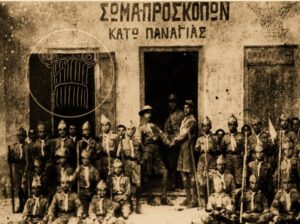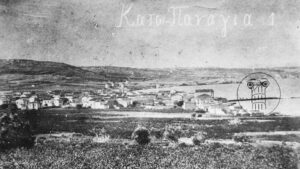
The following text was published in the commemorative edition of the Association of Kato Panagia, Asia Minor, titled *The Fiftieth Anniversary of the Upheaval (1922–1972)*, and recounts one of the most harrowing incidents from the final period preceding the uprooting of the inhabitants of Kato Panagia.
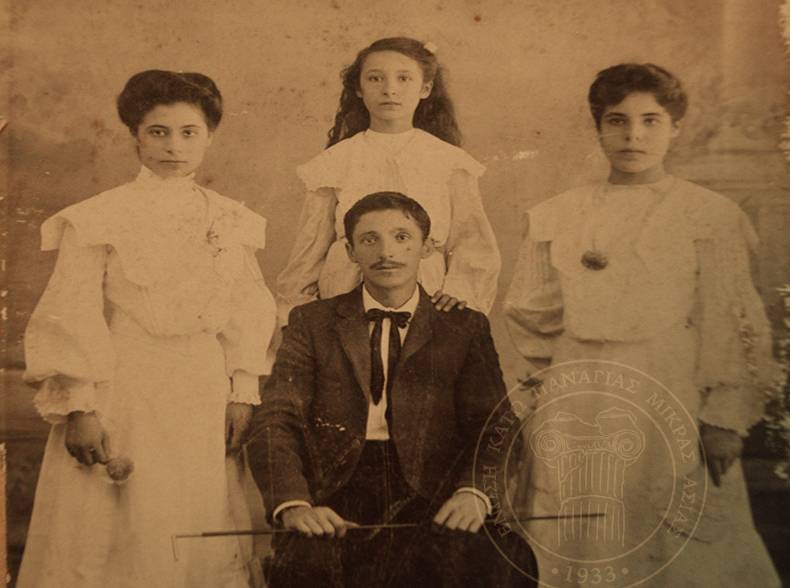
The narrative preserves the memory of the sacrifice of three young women from the village—Garyfalitsa Ververioni, Argyro Chatzithanasi, and Maria Pantela—who chose death over captivity during the tragic days of September 1922.
Το κείμενο αναδημοσιεύεται αυτούσιο ως ιστορική μαρτυρία και τεκμήριο της συλλογικής μνήμης των Κατωπαναγιούσηδων οικογενειών.
Historical Source:
From the publication "The Fiftieth Anniversary of the Upheaval: 1922–1972"
The dark days of September 1922 arrived. Uncertainty reigned. People in the village were not speaking to one another; they were merely trying to listen. But listen to whom? Who could possibly know?
That night, the village was pitch-black. Not a soul was stirring in the streets, and the houses had been tightly shut since early on.
Let’s see—will the Turks come tomorrow? And my thoughts turned to the villagers who had left. If only we had left, too…
And the Turks came. And they penned up everyone who had remained inside the church.
And the wailing and the slaughter began.
They took the men. They took the teenagers, too. Where did they take them? No one could give a clear answer…
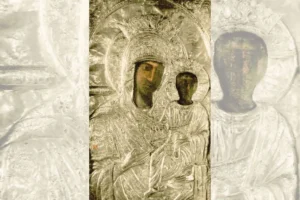
And the wailing and the carnage within the holy sanctuary of the Virgin Mary continued. It grew worse by the day! An unspeakable tragedy.
But, where were they found? three farsighted young womenThree who didn’t go to church. Three young women who stayed behind in their homes. Did they perhaps have a plan in mind? It seemed they did. The houses where they hid had their main entrances facing the high road. But behind the house lay the courtyard, and beyond that, the fields, the vineyards, the trees, and the open road leading to the countryside—to escape... and God is great!
The three young women remained well hidden as the days dragged on. What had become of their loved ones? Were they still alive? That thought suffocated them, alongside the crushing weight of uncertainty. Their solitude turned into a sheer nightmare. What would become of three defenseless young women?
Through the closed windows, they tried to listen. Through a crack, to see. To hear something, to see something.
They were terrified by the sound of the horse’s hooves. They would catch sight of a Turk—a soldier wearing a black fez. Fear mounted. Sheer terror took hold. And despair set in when they realized for certain that the Turks were breaking down doors.
They clearly heard the sounds of smashing and shouting, and witnessed the looting. Turks from the neighboring village of Vatziki had come. They trembled at the thought that, sooner or later, their own home’s turn would come too.
And they were planning an escape. A heroic escape. They were in Fountanomachalas; that was where they had gone into hiding. The plan was to leave the Kirikli area, make their way to Piso Gialos, and perhaps head for Samos by boat.
Another thought: what if they made their way down at night, taking backstreets toward the harbor? They could head for Giakas, then descend through the Hatzimorakika and Tziotika neighborhoods on their way to the port. Perhaps a boat might offer them a chance at salvation. They would head for Chios.
They decided to carry out their plan the following night… Tomorrow night—and God help us…
But it seems the house where they were hiding also had its turn in the looting.
Kicks to the door, iron pickaxes, and crowbars force the doors to give way.
The young women run fearlessly into the yard. They unlock the gate and dash out into the fields. They run like mad. They veer off course, fall, and choke with anxiety.
And now, the sound of gunfire. They’ve been spotted from somewhere. Yet, the shots aren't aimed directly at them. Oh, how they wish they were. A single bullet, and it would all be over. But the firing continues. The young women are misled. They turn back toward the village. Perhaps they’ll find a house left open and save themselves—stay safe until nightfall. And then, at night, the plan for escape.
That is exactly what the Turks wanted, too: to capture them alive.
Their frantic flight brought them back to the main road. But the houses... inhospitable. Shut tight. And the Turks were closing in.
"We’re done for if they catch us," they think. And they run like madmen. You turn into a beast when you see death staring you in the face. And you stop caring about anything else when the Turk is hunting you down.
The young women were lost. The Turks were drawing ever closer. Just a few more meters, and they were caught…
Help me, Holy Mother...
There before them lay the mouth of a well—wide open, inviting, a final, tragic salvation!
As they ran, they were also crossing themselves…
And look, the first one is... Garyfalitsa Ververioni, fearless, a spirited heroine—like another Souliot woman—she throws herself into the deepest well.
The second one follows, Argyro Chatzithanasi.
And third is Maria Pantela…
Her three young women from Kato Panagia, through their tragic deaths, they brought to life the legends and stories of their homeland.
They wrote a golden page in the history of our village.
We too commemorate their tragic sacrifice today, with the assurance that we will never forget our heroines. Their memory will be for us, αιωνία.
The Unredeemed have been redeemed.
Source: The Fiftieth Anniversary of the Uprooting (1922–1972), published by.. Association of Kato Panagia, Asia Minor